Ground Zero
· Automatically translated from Italian
The tragic attack on the Twin Towers marked the beginning of the third millennium, creating a material void that reflects the deep cultural shortcomings of the West, and indelibly shaping the historical, social, architectural, and urban landscape of New York.
The event, whether emotionally or practically, addresses the theme of reconstruction and dealing with voids: the most prominent aspect, immediately apparent in the case of the void left by the Twin Towers, is its inherent relationship to something external to itself. This is a perceived negative absence, which, like a parasitic relationship, cannot exist without the very thing that, on a material level, created it. Society responds to this with a natural defense mechanism: it attempts to soothe the wound.
By framing the issue on an emotional level, we can observe how the grief caused by such exceptional and shocking events brings to the surface certain characteristic traits of humanity – compassion, empathy, and selfless dedication – which ennoble human nature and, in a period of emotional detachment and indifference, can redeem it.
A distinctive feature of the void is its close connection to time, which constitutes a condition for its existence. Its presence is dependent on the experience of something that was previously whole and complete. It is impossible to perceive the absence of something without knowing its original state, whether that state exists within a painting, a sculpture, or a monument.
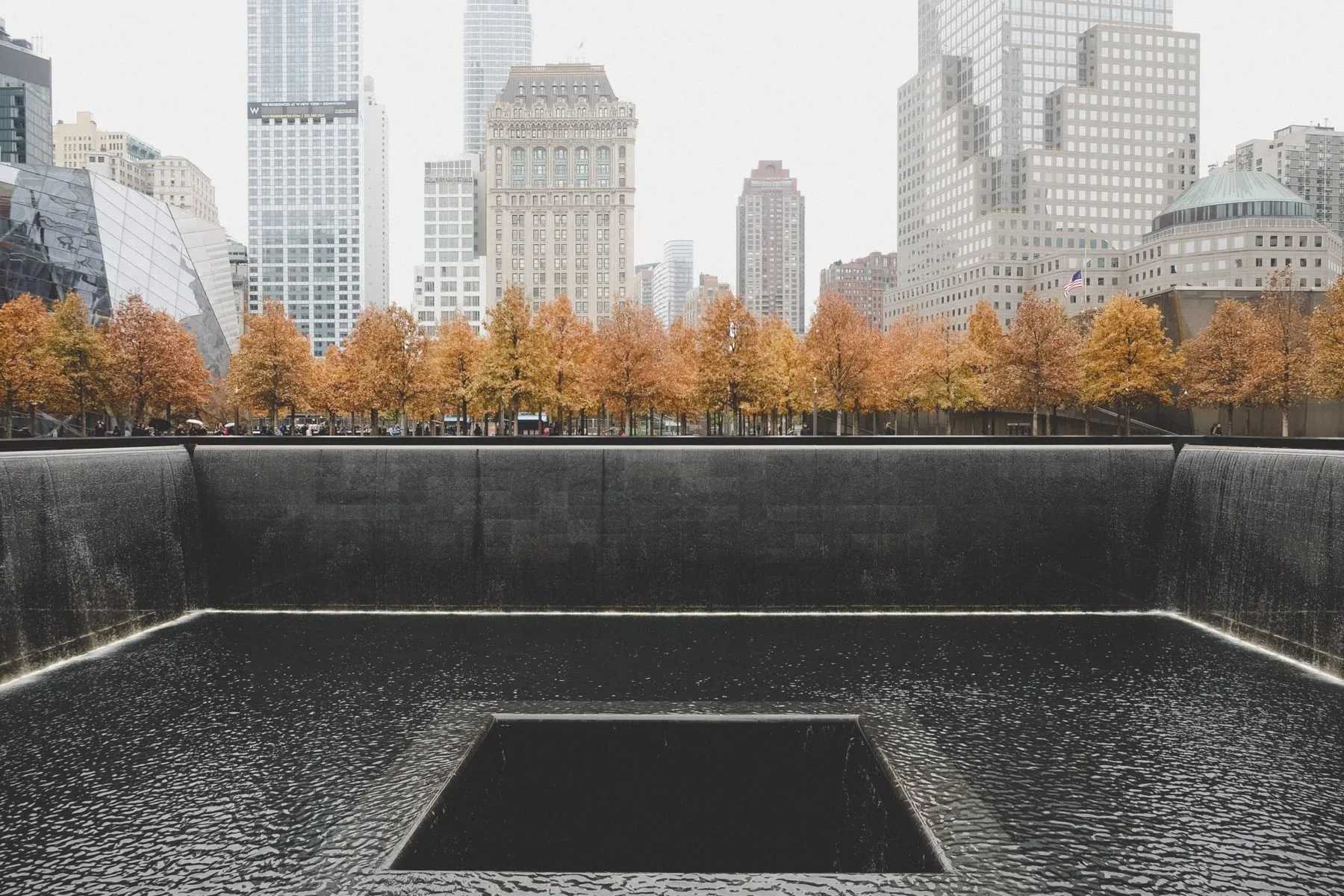
From this perspective, “Reflecting Absence,” the monument designed by architect Michael Arad in memory of the Towers, which we see photographed on these pages, offers a unique approach to dealing with the void. It’s not difficult to imagine that what was once a symbol of American economic power and progress could have been rebuilt, or even replaced, by a new building that, over time, would have become a new symbol and superseded the old towers.
But the human lives lost and the void created by this event in the complacent tranquility of the entire Western world could not and should not be relegated to a secondary position, in any way or at any time. “Reflecting Absence” expresses this determination with silent resolve: the symbolic choice not to rebuild, but to emphasize the absence that has been created, is all the more evident on a perceptual level, being located in the heart of the city’s bustling skyscraper district. This plays on the alteration of the figure-ground relationship, enhancing the hierarchical inversion that places the void in the foreground and relegates its context to the background. The fact that it is something other than the surrounding environment, a materiality generated by the absence of matter, and its persistence over time as a void, guaranteed by the growing disparity between the constantly increasing construction density and the null volume of Ground Zero, gives the monument an extraordinary communicative power, which will undoubtedly remain for many years to come as a symbol and a warning for future generations.