Aravena: a short side note
Riccardo Bartali · · Automatically translated from Italian
It’s always easy to jump on the bandwagon of the winner and to ride the wave of excitement surrounding a newly overturned vessel, and the article we published about Alejandro Aravena upon his victory might seem like an attempt to capitalize on a trend, with its enthusiastic tone.
Similarly, many others on the opposite side have expressed their opinions in recent days, both in Italy and elsewhere; but it’s good when a debate arises about the value of an architect, and the discussions become heated when people talk about how widely a particular opinion might be shared. However, I don’t think this is quite the case, or rather, the controversy exists, but it seems sterile and somewhat naive in its terms.
A necessary clarification regarding my comment: the Pritzker Prize, like the Nobel Prize, the Oscar, the Golden Globe, or the Pulitzer Prize, is an award. As an award, its purpose is not simply to celebrate the absolute best, but to guide a particular phenomenon. The Oscars and Golden Globes rarely go to the same films for the same reasons; instead, they are divided to recognize the various merits a film might possess in order to achieve box office success. Similarly, the Nobel Peace Prize rewards those who are expected to do something positive. Therefore, there’s no reason to complain if an architecture award is given (as the jury’s statement suggests) to guide a generation:
“The younger generation of architects and designers who are looking for opportunities to affect change can learn from the way Alejandro Aravena takes on multiple roles instead of the singular position of a designer to facilitate a housing project, and by doing so, discovers that such opportunities may be created by architects themselves.”
Thanks to Facebook, the usual source where our most controversial instincts are fed, I had the opportunity to read the criticisms leveled at this victory. Some criticisms revolve around the idea that “he must have been a judge, he was probably recommended,” and these should be dismissed quickly: whether they are true or false, they are unproductive for a meaningful debate or, at the very least, for developing critical thinking. Perhaps it’s best to leave them for the radical-chic salons of tabloid journalism, alongside the impending separation of Belen Rodriguez and the “TotoMorto” 2016 (literally, in parentheses: I’m putting all my money on Pippo Baudo).
Other criticisms, the more insightful ones, focus on the perceived lack of “experimental” qualities in his architecture, and the assertion that he is a mediocre architect but a good communicator, capable of selling himself in press conferences or through press releases. If this is how the news has been received, it’s not surprising that Italians view this prestigious award with a magnifying glass. Aravena, despite not being overly “promoted,” with his “think tank,” is legitimizing and making politically correct a new vision of architecture that, apparently, the academic world rejects (much like it has always struggled to accept the idea that an engineer could build, as seen with Frei Otto and his posthumous Pritzker Prize “prank,” or Buckminster Fuller).
Money is becoming scarce. The virtuous, Taylorist model, which had its heyday in the 80s and 90s, has exhausted its positive influence, and its negative effects are fully felt in the ongoing local economic crises and the decline of welfare states. The architectural model is in crisis, and the discipline, with its associated artistic philosophy, is undergoing a significant period of change, driven by the speed of information and the advancements in technology that allow almost anything to be created in any dimension in a short amount of time, starting from nothing. In many countries, bureaucratic systems are being streamlined to cope with this, and new laws are being enacted that change the way we think about housing (in Italy, of course, we are still trying to understand what renewable energy is, let alone the idea that zoning might be unnecessary, or that we all have the right to build our own homes with our own hands without involving a construction company and spending a fortune). In architecture, the idea is emerging that a different way of doing things is not only possible but desirable.
Architecture is an art as long as it can communicate intimately with people. It communicates not only through plastic arrangements of rhythm and composition, but also through the fulfillment of certain human needs and desires, such as living well, or not being a burdensome weight that conditions your entire life, and the possibility of expanding spaces and experiencing them to the fullest. Just as the internet has given rise to open-source encyclopedias and Creative Commons, so too is an open-source architecture emerging, one that is accessible to the user, adaptable, and that can add value to architecture through its full availability and freedom.
Alejandro Aravena, in some of his projects, found himself working in challenging environments and with limited resources. He relied on these new architectural principles: “do, don’t just think.” Thinking is the task of those who will use those spaces; the “doing” must be supported and assisted because not everyone has the necessary knowledge. The architect is like a conductor, capable of creating a structured score and a supporting harmony, providing musicians with the freedom to emphasize the sounds they want and to realize what they feel most connected to.
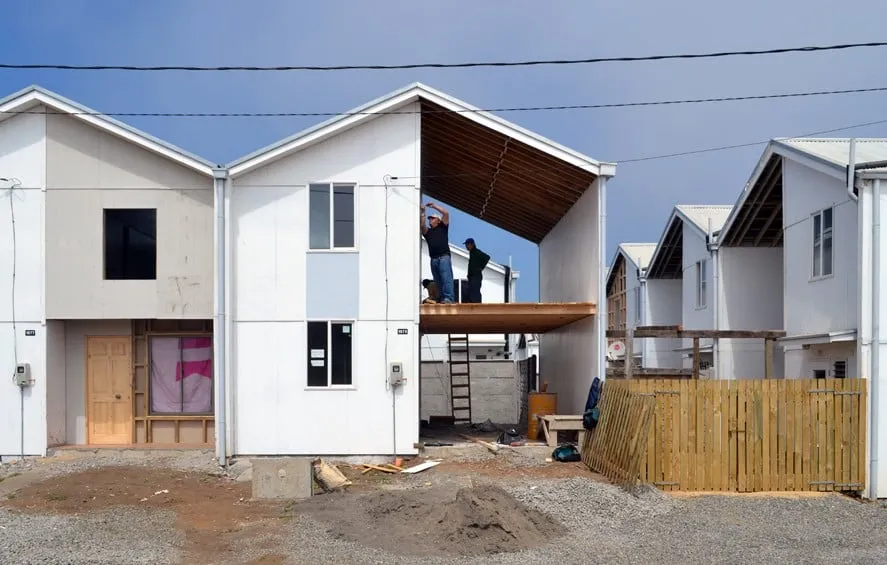
In many criticisms, I see more an inability to understand this phenomenon, which is not a fleeting trend, than a genuine judgment of its value. People talk about mediocre artistry, a lack of research, and compositions that are reminiscent of a schoolboy’s work, failing to realize that the research (although not always innovative, it has been ongoing for ten years worldwide) focuses on the design of self-managed, self-built, and directed spaces, but not imposed ones. Aravena has created, in some of his projects, a perfectly functional half-house, which, in my opinion, is also beautiful. He then provided the structures to continue and adapt the construction, leaving exposed beams or voids within the masonry. Many researchers in the field have gone even further, but perhaps they are too radical to be accepted by a broad audience and the entire academic community. The Chilean architect was the most palatable and understandable, easy to grasp, and full of impactful ideas, with a distinctive personality and presence, and that’s why he succeeded: to push architecture in a different direction.
Perhaps I was wrong then; I haven’t read any critiques, otherwise I wouldn’t have written this lengthy footnote. Maybe I’ve only encountered blindness and fear. The inability to see a little further into the future, and the unwillingness to open one’s eyes to social and technological realities, and the fear that architecture will increasingly become a space for humans and less for accumulating money. Or perhaps I am simply reading myself, the reasonable part of me that I hate, and that wants to speak and tell its stories.
Fortunately, and may it be so, architecture must always and undeniably be beautiful, whatever that word may mean.
© Cover image: ELEMENTAL // Villa Verde – Constitución, Chile