Lacuna
· Automatically translated from Italian
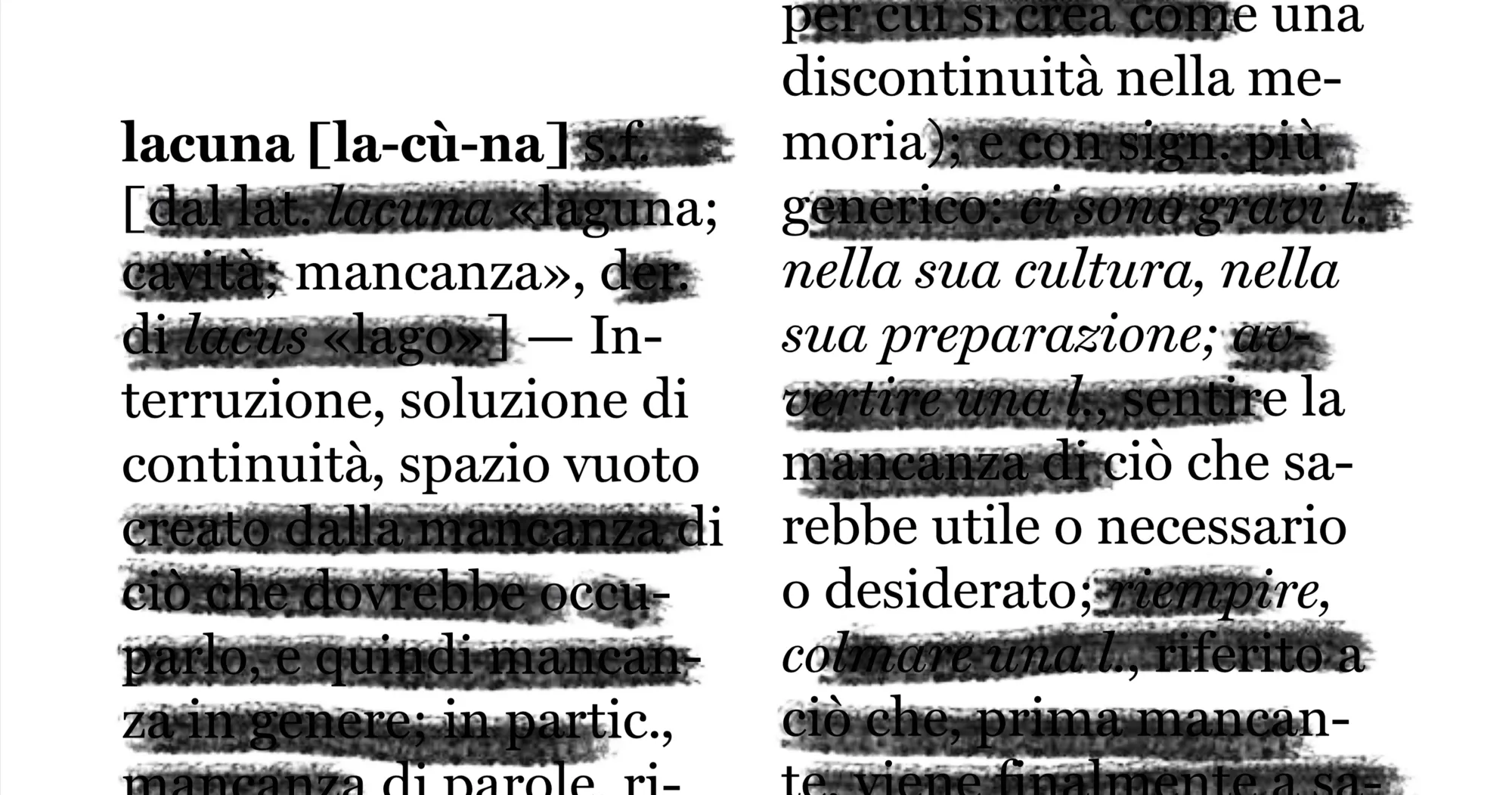
In literature, a gap, censorship, or reticence represents an intentional omission, the art of “what is not said,” where the text gains its value through the quality of the voids that encourage the reader to engage in a pleasant effort of interpretation and participation in the work. In architecture, however, this relationship is reversed: when faced with a gap, one questions the continued usefulness of the structure. The term then acquires a negative connotation, representing a deficiency that must be addressed to allow for a coherent and consistent understanding of the built environment.
During the Renaissance, the tendency to interpret the “void” or “gap” in a way that emphasized artistic merit significantly influenced the work of architects in their often arbitrary renovations and interventions. While it is true that this period saw a genuine humanist revolution and a valuable search for and documentation of classical antiquity, it is equally evident that the individual sensibilities (of the architect or the client) determined what was to be valued and how, and what was to be destroyed to make way for the new. Carlo Ceschi, one of the leading Italian theorists of restoration, writes on this subject: “But when the goal was to create something new, there was no hesitation in sacrificing a pre-existing building, as Pope Pius II did […], ordering the demolition in 1459 of the Romanesque church of Santa Maria in Pienza and replacing it with the new cathedral. […]. Humanism, it seems, was limited to an appreciation of classical antiquity and failed to extend this appreciation to the architecture of later centuries.” The strategy for filling the “void” was always solely dependent on the dominant personality of the architect, who incorporated the object of restoration into their personal vision. This is what happened with Brunelleschi’s dome or Alberti’s facade of Santa Maria Novella.
The evolution of the study of antiquity and a growing awareness of the subject subsequently led to new and interesting Neoclassical approaches, which resulted in a move away from methods based on personal discretion, towards a greater respect for the integrity of the figurative elements. A prime example of this is the restoration of the Arch of Titus, which began with Raffaele Stern in 1818 and was completed by Giuseppe Valadier. Through meticulous work involving the reconstruction of missing sections using the anastylosis technique where possible, and the completion of other areas using materials different from the original with simplified finishes, not only were the gaps filled, but at the same time, a deliberate trace of the restoration was preserved, creating a masterful example of conservation.
Two schools of thought emerged in the 19th century: that of Eugène Viollet-le-Duc, whose historical sensitivity and expertise led to the “stylistic” additions and reconstructions of numerous medieval buildings in France. The other was that of the Englishman John Ruskin, who, in contrast, condemned his colleague’s interventions, arguing for the artistic and romantic value of the marks of time on monuments and ruins. Despite both having profoundly influenced thinking on the subject for centuries to come, Ruskin’s perspective represented a completely new, albeit radical and theoretical, approach to the issue of restoration: there is no need to restore, complete, or revive an object from another era that has already completed its life cycle.
Parallel to the evolution of critical thinking regarding restoration, the approach to dealing with gaps or missing elements from an artistic perspective remains one of the most important aspects of professional judgment in architectural restoration. While there have been repeated attempts to codify its fundamental principles in a clear and scientific manner, this remains a complex and nuanced area.
While Camillo Boito’s eight principles, later incorporated into the “Athens Charter” of 1931, advocated for the definitive rejection of additions, except for those involving anastylosis (reconstruction using original fragments), the 20th century once again reshuffled the deck. Two new principles were introduced: the principle of “minimal intervention” and the principle of “recognizability,” which established the preservation of the original work as the new primary goal.
However, there have also been instances where the primary need to be addressed has been of a socio-psychological nature, referring to the painful absence of an element that defines one’s cultural background. This is evident in the restoration work carried out in the aftermath of the conflicts of the 20th century, particularly starting from the end of World War II. The reconstruction of many monuments often followed the principle of “exact replica,” a methodology that was frequently favored by public demand because it was the only approach that, in conditions of severe destruction, could bring back to life the lost artifacts – albeit as soulless reproductions.
Faced with these situations, numerous reconstructions and renovations have taken place, each with its own unique approach, but all driven by the same desire to reclaim a “piece of identity” that had been lost. A good example is the reconstruction of some ancient bridges, such as the wooden bridge in Bassano, dating back to 1569 but already rebuilt twice in 1749 and 1821. This bridge has seen its third replica, still faithful to the Palladian design, after being destroyed in 1945. Another example is the bridge in Florence at Santa Trinità, which was rebuilt not only with stones collected from the Arno River, but also using the techniques of 16th-century craftsmen, rather than with a modern structure later covered in stone, because otherwise, its “appearance would not have been the same.”
Subsequently, there was a need to “reaffirm the ancient principles.” With new awareness emerging in the field of urban environmental protection, the Venice Charter was drafted in 1964. However, the awareness of the complexity of the issues involved was not forgotten. In this regard, Ceschi himself wrote:
“The events I have mentioned […], clearly fall outside the ordinary methodological routine codified in the regulations, instructions, and guidelines for restoration. […]. However, the reconstruction of the monumental heritage after the war is an indelible chapter, and precisely because it was exceptional, it could not be overlooked.”
It’s important to emphasize that when discussing the restoration of a building or urban area, as opposed to a work of art in general, a fundamental variable is added: the function, the ability of the building or urban space to still be useful for its original purpose. The utilitas of the famous Vitruvian triad is often the starting point of the long process that has led theorists and experts from various eras to address the issue of incompleteness, resulting in a vast body of literature over the centuries and fueling a lively debate that is far from being concluded, and which we have attempted to summarize here. Furthermore, recent catastrophic events have introduced a new variable into the complex system of balances within this field: the symbol. The symbolic interpretation of certain gaps caused by destructive events, whether natural or human-caused, has generated innovative and highly communicative examples that encourage reflection and pave the way for new design approaches.