Urban planning · Visual arts · Architecture
Rossi, the Theater, the movement
Fabio Santaniello Bruun · · Automatically translated from Italian
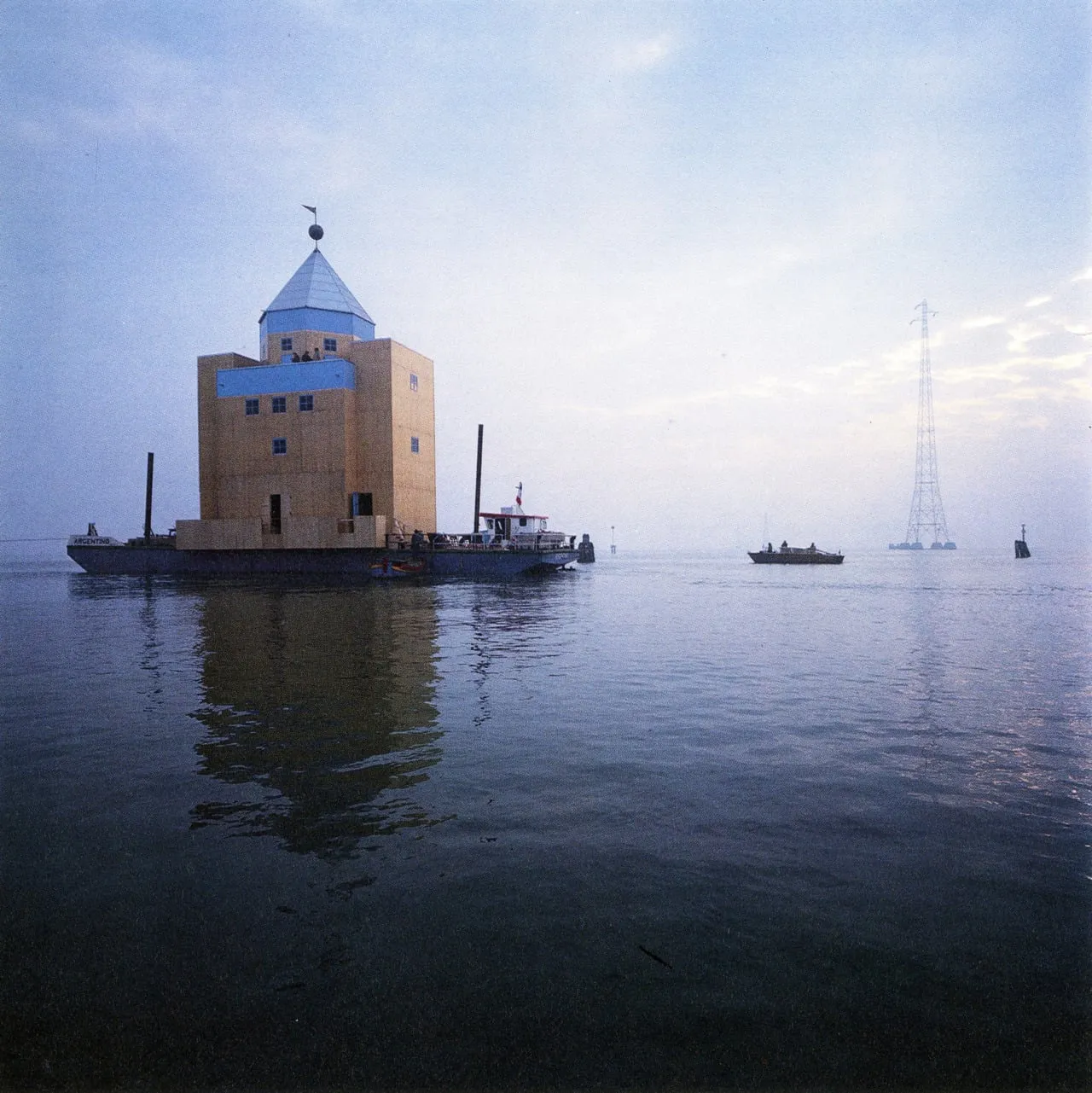
In 1979, the Venice Biennale commissioned Aldo Rossi to create what has since become perhaps the most iconic symbol of the Biennale and of Rossi’s own work: the “Teatro del Mondo” (World Theatre). This evocative name is laden with symbolic meanings, subtly hinting at the architectural principles that underpin this project, which is essentially a manifesto of a particular approach to architecture.
Built with the awareness of its temporary nature, the theater was constructed with a steel frame, easily assembled and disassembled, covered with wooden planks, and mounted on a barge that allowed the structure to float on the canal and be transported from one bank to the other. Approximately 25 meters high, the main structure consisted of a square prism, about 9.5 meters on each side and 11 meters high, which could accommodate up to 400 people. Adjoining this prism, two stairwells, symmetrically arranged, rose about two meters higher than the central body. Covering the central body was a pavilion with zinc roofing, set on an octagonal drum, which formed the “attic” level of the theater and was surrounded by a perimeter terrace. At the peak of the pavilion, a sphere and a triangular flag completed the structure.
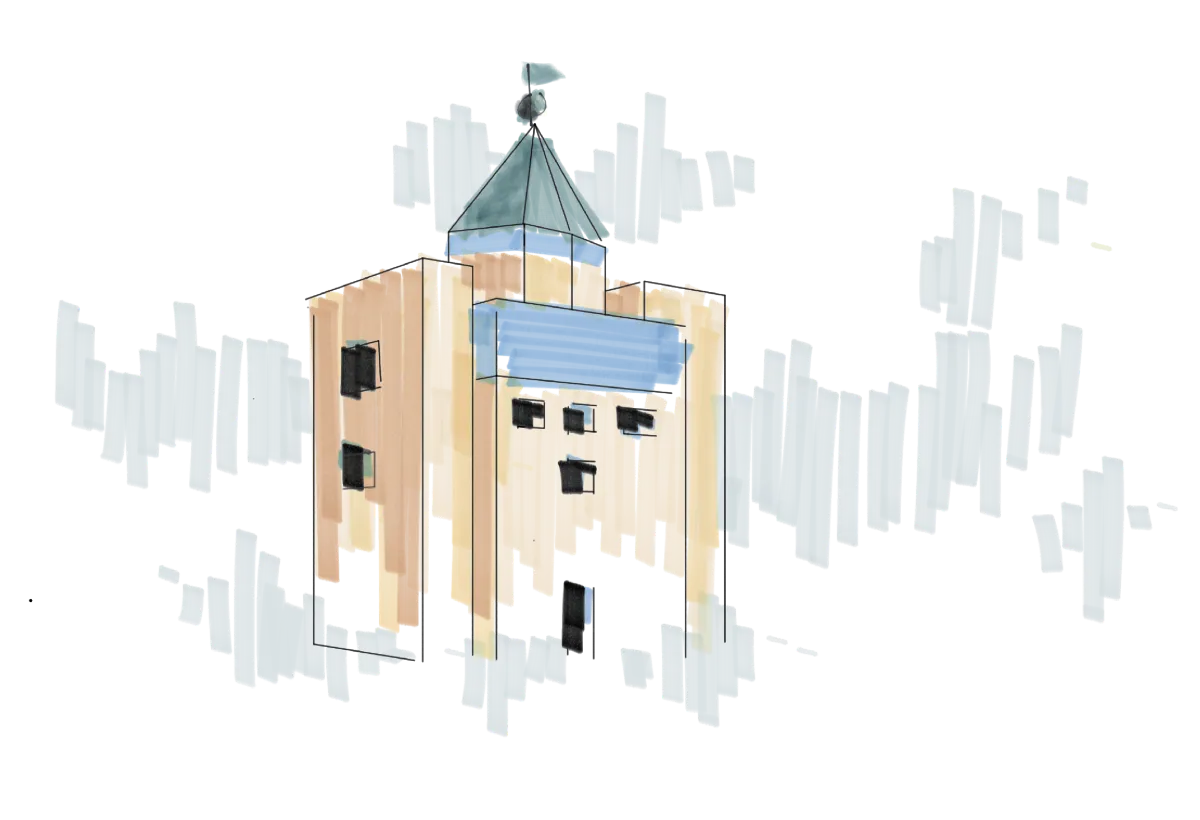 Illustration by Fabio Santaniello Bruun
The theater is a unique architectural element with a dual nature. Firstly, it functions as a space designed to accommodate a large audience and to optimize the performance by the actors. This includes appropriate height, technical spaces, state-of-the-art technological and mechanical systems, and lighting designed to provide excellent visibility of the performance. It’s not fundamentally different from a school, a post office, or a tea room: the function dictates the form, which is either aesthetically refined and offers a rich experience, or a simple example of “building” according to a textbook.
The second aspect of the theater defines it as a “meta-space,” a text representing the agreement that the audience makes with the actors. This agreement is analogous to the narrative agreement established when reading a novel. Once you enter the theater and take your seat, the lights dim, and “the architecture ends, and the world of imagination begins.”
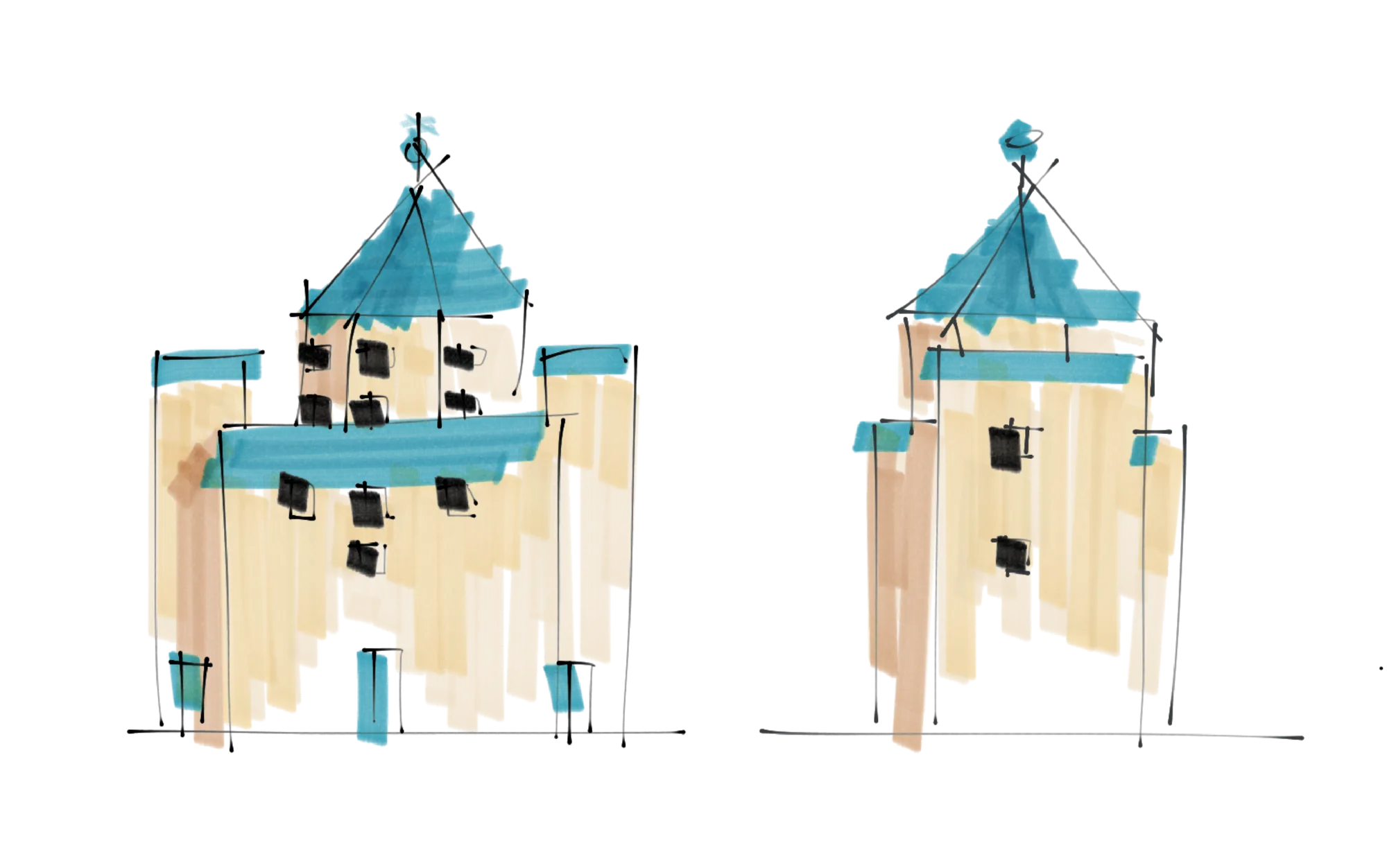 Illustration by Fabio Santaniello Bruun
Therefore, the object-theater possesses a dual nature: architectural and metaspacial. Rossi imbues his “Teatro del Mondo” with a third quality: that of the ephemeral. Born from the murky waters of the lagoon, the “Teatro del Mondo” was a materialized realization of a type that Aldo Rossi kindly brought down from its timeless pedestal: subjecting it to the temporal gravity of the present and the distortion of a deeply personal interpretation. The architect transformed the 18th-century “teatrino” into a model that was a product of its time and place. Thus, a floating architecture was created, a volume that was “shaped by the movements of Venice,” necessarily on the water and therefore mobile, possessing “a precise, albeit undefined, usable space.” If the location of the work was in constant motion, then so too was its time, limited, evanescent, and undefined – the time of a midsummer love, a feverish and uncertain season marked by the approach of autumn. The 18th-century “teatrino” was temporary, constructed from wooden planks covered in ornate stucco, and so too was the “Teatro,” existing for a fleeting moment in Venice before being swept away towards the Albanian coast.
Just as it began, the “Teatro” ended: in memories and through memories. It was a portal that allowed one to experience a parallel time and space, that of the performance being presented. However, it itself passed through a temporal threshold: an object that entered the historical present for a brief period to embody the timeless idea of a carnival theater, adorned with the mask that Aldo Rossi skillfully crafted.
Bibliography and Web Resources
- A. Rossi, Scientific Autobiography, Parma: Pratiche, 1990; revised edition, Milan: Il Saggiatore, 2009
- Fondazione Aldo Rossi, Teatro del Mondo, Venice 1979, http://www.fondazionealdorossi.org/opere/1970-1979/teatro-del-mondo-venezia-1979/
- The cover image is used under the principle of Fair Use: we were unable to locate the source or the copyright holder. Do you know who it is? Let us know!!