10 hours at EXPO (even that is too many)
Alessandro Ariel Terranova · · Automatically translated from Italian
Milan is a whirlwind of activity, constantly on the move. The northern capital seems determined never to rest, always seeking new ventures, projects to launch, and boutiques to illuminate. It wants to do, do, do. It embraces proposals, initiatives, and starts projects, always striving for something more. It aims to be a European capital of culture, fashion, and entertainment. It achieves this to some extent: its undeniable charm and appeal resonate throughout the entire country and beyond the Alps, which separate us from our neighbors. However, it remains fundamentally Italian. It often focuses on the “big splash,” trapped by a mindset still attached to the allure of glossy magazines, superficial and fleeting, where a bold headline is enough to make the news and fuel gossip, while the rest of the article, the supporting details, the in-depth analysis, the problems – all remain secondary
On June 5th, Nike organized a 10km women’s marathon starting from Piazza Gae Aulenti – the square at the base of the Unicredit Tower, where a large Nike store is located – and passing by the city’s main attractions: the Pavilion of Contemporary Art, Piazza San Babila, then Piazza Duomo, the Sforzesco Castle, followed by Sempione Park to the Arco della Pace, the Civic Arena, the Vertical Forest, and finally the Regional Palace, before returning to Piazza Gae Aulenti. Approximately 7,000 women (and a few male companions caught up in the wave of runners wearing the salmon-colored t-shirts that Nike provided to all participants) competed in the heart of Milan, from 8:30 PM for about an hour and a half, completely disrupting the city’s unprepared traffic. Yes, completely unaware, the average Milan resident had no idea about the race until, ready to return home after a long day of work, they found themselves completely blocked by a horde of runners who, for at least an hour, invaded the city’s main traffic junctions: no posters, no warnings on the streets.
Regarding the EXPO, it’s safe to say that Milan and the entire country were well aware of it: on television, every advertisement from a brand even remotely related to food is either a sponsor or an official partner of the event, constantly reminding us to buy tickets (which cost 34 euros, and slightly less for students) and visit the largest “food” event ever planned.
We spent ten hours at the EXPO, from shortly after the doors opened until dinnertime, and the experience was far from what one might expect from a major international event. Or perhaps not, considering the host country and the initial criticisms that are already circulating online and on some television programs.
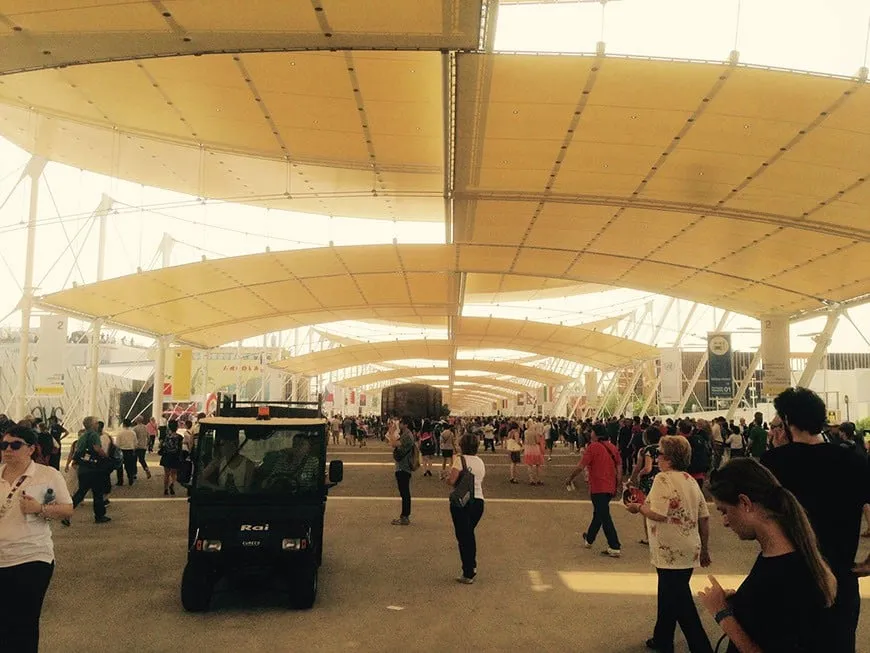
View from the beginning of the Decumanus
9:30 AM
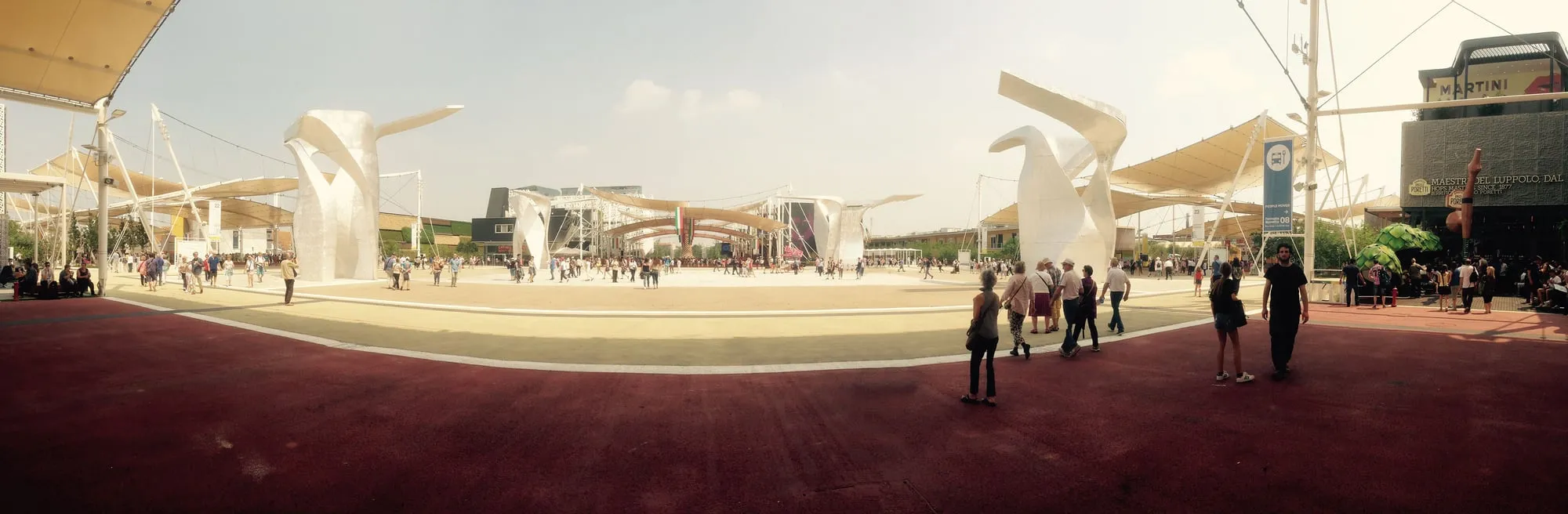
We arrived at the security area at the entrance after a long walk across the bright white bridge that connects the Rho metro station to the entrance. The heat was already unbearable, but fortunately, the line for the metal detector was short and moved quickly. We entered, passing alongside the Zero Pavilion, and arrived at the beginning of the Decumanus, where an unmanageable line prevented us from visiting the Irish pavilion. We tried the Czech Republic, which opens onto the avenue with a small kiosk selling sandwiches and beer, overlooking a pool with a peculiar sculpture – a mixture of a pigeon, a car, and an airplane that sprays water from its wing. It was quite bizarre. In the shade of the overhang, a group of three girls were singing songs from the late 1980s in a rather ridiculous manner, but we moved on and went to the first floor, where we found a kind of artificial terrarium that was supposed to be a “silent room”: in the background, the three singers were still strumming away incessantly. Another room displayed some glass art from Karlovy Vary and not much else. On the roof, there was a panoramic terrace designed to resemble an undergrowth, with dried moss and slate fragments: “over 350 square meters of a ‘living laboratory’,” according to the expo2015.org website
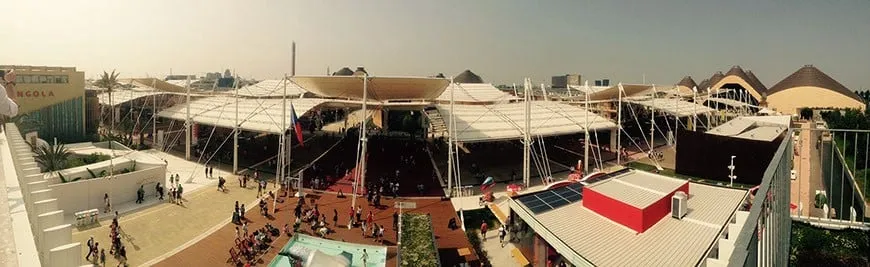
From the terrace of the Czech Republic
9:00 AM
Nepal, Sudan, Belgium, Brazil, Angola: all were inaccessible due to long queues. We wonder how it’s possible that the pavilions were designed so poorly as to prevent a smooth flow of people, even on a day without any special events scheduled – we can only imagine the chaos of the first few days of opening. We sought refuge in the Bahrain pavilion, where a winding path of white concrete led us to discover small flowerbeds and terrariums with plants typical of the country, culminating in a bar that served unappetizing croissants and sandwiches.
We returned to the main avenue, where Technogym stands alternated with dioramas created by the renowned set designer Dante Ferretti at Cinecittà – meticulously crafted, but ultimately useless and inappropriate – depicting fruits, vegetables, cheeses, meats, and fish: fake market scenes from a film set in a prosperous Middle Ages, where tomatoes are flawless and pigs roam freely in the courtyard amidst mud and straw. However, tourists seemed to appreciate these anachronistic displays, and many took selfies in ridiculous poses.
9:30 AM
The Spanish pavilion is majestic and inviting. By the end of the day, we realize that it is somewhat the emblem of the entire exhibition. The wooden architecture resembles a colossal house, formed by the repetition of pointed wooden arches, each about 8 meters high. It’s a combination of shapes and technologies that houses a presentation of Spanish food and culinary masters. An installation of large screens and photographs accompanies the visitor on a journey that is both brief and ultimately pointless. According to the map we have, the theme of the EXPO, “Feeding the Planet, Energy for Life,” is developed by each country according to agreed-upon guidelines and in-depth theoretical and technological research. However, it seems that each country has simply thrown together a collection of disconnected elements from their traditional cuisine, resulting in a lack of coherence and originality.
12:00 PM
Fatigue and hunger begin to set in. We’re looking for a pavilion that offers some typical food, something special and different from the usual hot dogs or plain sandwiches with fontina cheese. There’s nothing in sight; fortunately, the “supermarket of the future,” a futuristic Coop store, saves us from the exorbitant prices of the snack stands, which are not dissimilar to those found at local festivals. Here, a half-liter bottle of water costs between €1.50 and €2.00.
1:00 PM
“Il Cardo” (The Cardo), a showcase of Italian regions… or perhaps it’s better to say, of the major Italian food companies. Facade architecture, no real content, just pure advertising: San Pellegrino, Ferrero, Algida, Granarolo, Birra Moretti, and so on; a building on the corner of Piazza Italia, the square where the avenues meet and is completely exposed to the sun, is empty and uninhabited. Okay.
It’s interesting to draw a parallel with John Foot’s experience, who writes for Internazionale: “I’m sorry to say it, but the restaurant at the Slow Food pavilion is deserted. The McDonald’s next door, on the other hand, is packed. Feeding the planet. There’s nothing to say.”
So, it’s time to eat. This part will definitely be good. It has to be, after all: the whole point of the Expo is to talk about food. There’s a stand from the region of Trentino with a sign that says “tasting,” and many people are waiting around it. Yet, no one is eating.
I opt for the restaurant from the region of Marche (the restaurants are organized by region). A plastic tray and a small plastic bowl filled with overcooked and cold pasta. Ten euros. It feels a bit like a canteen at a labor union. The surreal nature of this lunch is amplified by the soundtrack: “La locomotiva” by Guccini (yes, I swear). At least someone has a sense of humor.”
2:00 PM
We continue our walk; the heat is devastating, but fortunately, at least the two avenues are in the shade, and there’s a bit of a breeze. The pavilions are all inaccessible due to the long lines, which are, of course, in the sun. We try the Russian pavilion: a waste of time. Oman looks like a large reproduction of the set from an Aladdin movie filmed in the early 1970s, complete with fake rocks made of fiberglass and a “castle” of luxury in the desert.
Next to the Biodiversity Plaza, with the Slow Food pavilion, is the Mediterranean Hill: a pile of excavated soil covered with dried and sun-baked rosemary and sage. We turn around and try to do a second loop.
The Estonian pavilion is right next door, two stories high. If you go up the stairs, you’ll find two tables with scented candles and souvenirs.
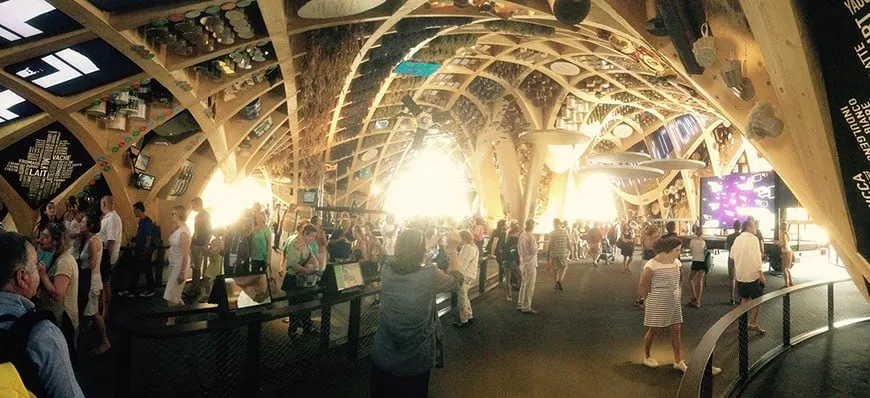
French Pavilion
Let’s take a walk around the outside of the German pavilion, stopping for a beer. In the outdoor auditorium, they are showcasing an online video game. We then pass by Coca-Cola, American food trucks, Federalimentare, Alitalia, Etihad Airways, and finally arrive at the French pavilion. This one is definitely worth a visit: it’s entirely made of laminated wood, organically shaped, and has a fascinating atmosphere. As you leave, you can buy baguettes for around 4 euros.
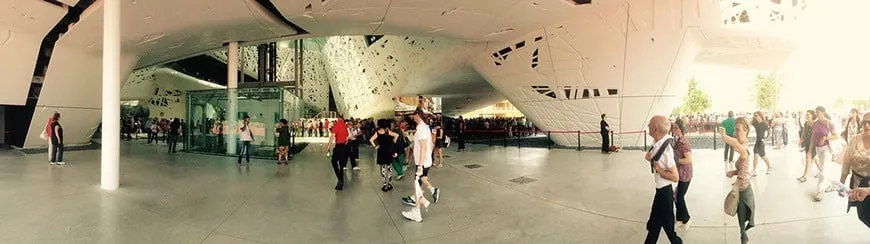
Interior of the Italian Pavilion
3:00 PM
The Italian Pavilion. An example of unfinished work, a shame it wasn’t signed by Michelangelo. If this is the kind of architecture that’s supposed to represent the excellence of design in Italy today, we’re in trouble.
There’s a long line to get in, and we’re not really in the mood to be disappointed again. We settle for noticing the endless number of details that reveal how poorly the building was designed, poorly executed, and not finished, confirming all the negative opinions we had only heard about before. The architecture is crude and unrefined; the gaps between the cladding panels reveal entire arms, and it’s unclear whether some of these are intentional details or simply assembly flaws. Back home, a look at the designers’ website seems to suggest the latter.
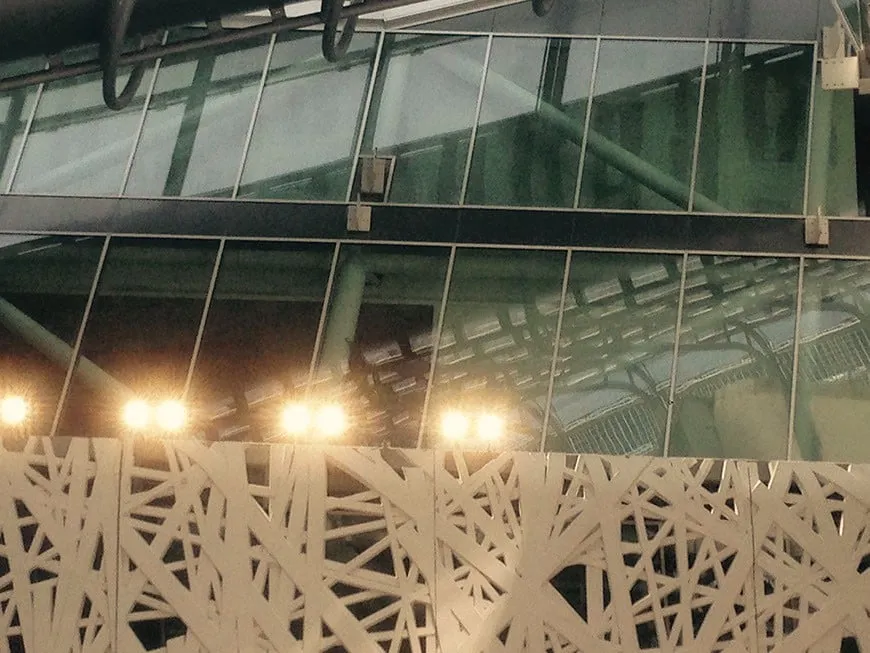
Steel plates that were supposed to support the supporting structure of the cladding panels, but which were left unfinished.
One positive point: we discovered a fascinating lecture by Steve McCurry about his new work with coffee plantations. Speaking with the Lavazza public relations representative who invited us to return at 6 pm, she also confirmed that many visitors she had spoken to had expressed their disappointment with the pavilion and with the EXPO in general… nothing new under the sun. We needed a break and managed to find a small patch of grass next to the main street where we could rest.
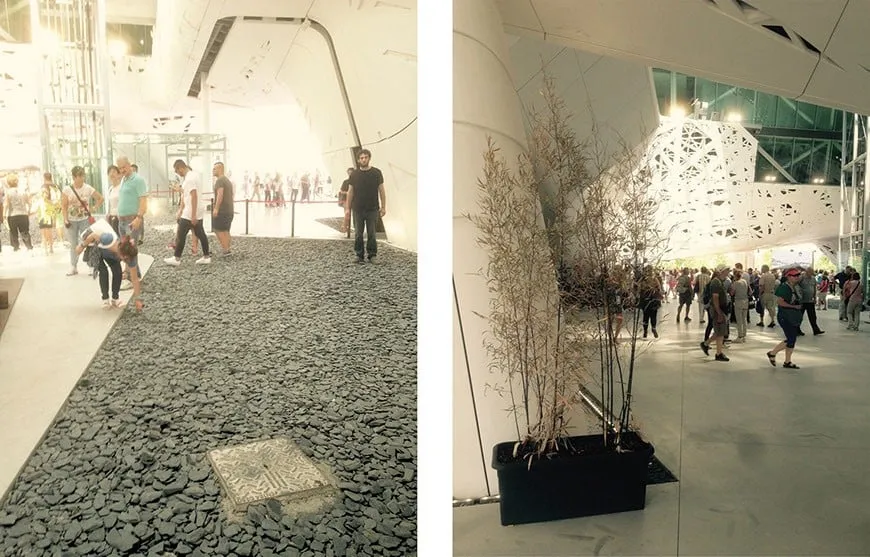
The interior of the Italian Pavilion, with its controversial design and aesthetic choices.
6:30 PM
Flag bearers on the main street. A medieval revival, with people in tights and velvet cloaks, paraded through, one of the many out-of-place attractions that disrupt the coherence of the exhibition, if such a thing was even being sought. People gathered around the group during a mediocre performance, partly due to the heat and lack of space. Along with the band that passes by twice a day and the mascot parade that seems to have just come from the promotional displays of a supermarket, it’s difficult to find any connection to the theme of the exhibition.
5:00 PM
We stop at a Coop supermarket to stock up on water and sugar for the final stretch, then glance at a few pavilions that offer nothing of interest before heading to the conference. The anonymous auditorium in Palazzo Italia is reached via what appear to be service stairs and a small door that could easily be the entrance to a storage room. We encounter McCurry, who, while waiting for 6:00 PM, has someone bring him a coffee and asks his guests where he can sit comfortably to enjoy it. He returned about half an hour later, perhaps he went to have his coffee in Piazza del Duomo.
7:00 PM
It’s impossible to use bicycles at the EXPO; they are all locked to the trees at the entrance to the security area. The only option is to walk. What a questionable choice. We stopped by the coffee pavilions, where the only truly interesting thing was the enormous photos by Salgado, promoted by Illy: the two coffee giants are engaged in a battle of artistic photography.
As dinnertime approaches, we decide to head home. The thought of another sandwich, chips, and other junk food makes us feel queasy, but our budget has already been stretched thin, and we can’t afford a meal at one of the pavilions’ restaurants. The lines at the more affordable places make it impossible to find a seat at a reasonable hour.
8:00 PM
We return to the subway and reflect on the day. The EXPO felt like a theme park that wasn’t very fun. We wonder what they will do with those pavilions once it’s over, and whether they will keep the signs that say “EXPO2015” on the construction sites. It’s hard to believe that just ten years ago, only 100 meters from that same subway station, Fuksas designed a futuristic gridshell to enhance an area of Milan for international exhibitions.
We’re not entirely sure we remember the theme, perhaps something about food. Or maybe it was about wasting a lot of money and water. Certainly, the second option seems more likely, given what we saw along the main avenue.